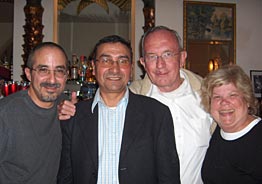
Amine, Mohamed, Craig and Brenda
In the film Casablanca the drama unfolds in the midst of a turbulent war as the characters pass through Rick's Cafe gambling, trading, negotiating and fighting for a better future. The dramas in today's Rick's are likely to involve people searching for the nostalgia of another time and reminiscing about the past. Last night a most poignant story unfolded, quietly, almost casually, at the bar during the music and lively atmosphere of our Sunday Jam Session. It was a crowded, boistrous Jam, with our usual trio of musicians and jammers Amine on the guitar and Paul on trumpet. I was in my corner seat at the crowded bar when two Americans about my age took the last two stools next to me and we started talking. Craig and Brenda had been stationed at the US Naval Air Station in Kenitra over 35 years ago, Craig had recently retired to Marrakech and Brenda and two other friends had come to Morocco for a reunion. Our conversation mainly involved his observations on Casablanca, mentioning he'd always wished there was something like Rick's here at the time. They were having such fun they booked a table for dinner, and soon were joined by a Moroccan friend. I had an ideal upstairs table for three giving a nice view of the central courtyard and the music. Then the story. Was I familiar with the 1972 coup attempt, the plot to shoot down King Hassan II's plane by Moroccan air force officers? In the early 70's tension was building, particularly in the Moroccan military, over high level and widespread corruption. A 1971 coup attempt against the King at his summer palace at Skhirat during his birthday celebration was unsuccessful, but resulted in the deaths of nearly 100 guests including the coup leader, General Mohamed Medbouh. Corruption continued unabated. Then in 1972 came a bold attempt by young air force officers to shoot down the King's B-727 as he was returning from France. As the plane entered Moroccan air space Moroccan F-5 jets pulled along side and opened fire. Defensive reaction by the pilot and decisive, split-second thinking by the King resulted in the plane safely landing in Rabat. The King's Minister of Defense and Interior, General Oufkir was deemed responsible and died that evening by suicide or murder. Half of the young military officers died in the immediate skrimishing that took place after the safe landing of the King. The family of General Oufkir, and surviving pilots and other participants were rounded up and eventually incarcerated in the notorious prison at Tazmamart where they remained for 19 years in deplorable isolation. When they were at Kenitra, Brenda had parties regularly and American and Moroccan military and civilians became fast friends. They were all young, idealistic and frustrated with the Viet Nam war, the political divisions and the human suffering. 
|
|
 The Americans talked frankly to their Moroccan friends and both sides expressed mutual frustration with the status quo in their respective countries. At Kenitra after the 1972 coup attempt, Craig, Brenda and their group were shocked to learn that some of their best Moroccan friends had been involved in the coup attempt and had disappeared from sight. They'd been sentenced to Tazmamart. The Americans were haunted by what had happened and wondered if their political discussions had had any influence on these young men's decision to take part in this rebellion against what they saw as a corrupt autocracy. Soon after Craig retired to Marrakech he came across "Operation Boraq F5, L'attaque du Boeing royal" written by Ahmed el Ouafi, one of his old friends from Kenitra! He bought the book and read it nonstop, fascinated to read the history of such a dramatic moment in Morocco's history but rendered stirringly personal as it recounted his friends' involvement in the plot and their later incarceration in Tazmamart for 19 years and release in 1991. He wrote the publisher and identified himself, asking them to pass a message on to the author. El Ouafi made contact and shared the phone numbers of two others, and when Brenda and other friends arrived they made plans to meet once again. Yesterday they met Casablanca resident Mohamed Al Zemmouri for the first time since 1972, and invited him to Rick's. As their story unfolded I was deeply touched, particularly by the strong bonds of friendship and all the emotions felt on both sides spanning more than 35 years. Mohamed was charming, modest, very human, and as Brenda said had "great skin." He told them it was one positive point for spending 19 years "in the dark." I invited them to join me back at the bar after their dinner and we spent more time talking about their days in Kenitra, continuing to marvel how this man evinced no bitterness and seemed so unscathed by what he'd been through. When the musicians were taking a break I went over to Amine and asked him if he was interested in meeting one of the participants in the 1972 coup - he did. And then I asked Mohamed if he would like to meet General Medbouh's son. Mohamed said, "of course." And soon the two were talking animatedly, and as it inevitably happens in Morocco their families are related. For Amine, as he told me later, this meeting, which was the first he'd ever had with the younger group of military from the 1972 coup, was a pleasure and a relief. He'd feared that there might be some resentment towards his father whose ideals had inspired these tragic events. He found instead a man who'd long buried the past, jettisoned any bitterness he may have felt and, comfortable with himself, was open to others. And Mohamed belied his age, just like Brenda had said. I asked him his age - 60. "You don't look it," I said. "Well, it's what I have to show for 19 years in a freezer," was the reply. So there it is, what I call the "Ultimate We've Been There Story," a true life vignette illustrating the spirit that draws people to this place - something seen in a movie that seems to be present here, fed, nurtured and inspired by the memories, stories and ideals of the people who walk into this gin joint. The Americans talked frankly to their Moroccan friends and both sides expressed mutual frustration with the status quo in their respective countries. At Kenitra after the 1972 coup attempt, Craig, Brenda and their group were shocked to learn that some of their best Moroccan friends had been involved in the coup attempt and had disappeared from sight. They'd been sentenced to Tazmamart. The Americans were haunted by what had happened and wondered if their political discussions had had any influence on these young men's decision to take part in this rebellion against what they saw as a corrupt autocracy. Soon after Craig retired to Marrakech he came across "Operation Boraq F5, L'attaque du Boeing royal" written by Ahmed el Ouafi, one of his old friends from Kenitra! He bought the book and read it nonstop, fascinated to read the history of such a dramatic moment in Morocco's history but rendered stirringly personal as it recounted his friends' involvement in the plot and their later incarceration in Tazmamart for 19 years and release in 1991. He wrote the publisher and identified himself, asking them to pass a message on to the author. El Ouafi made contact and shared the phone numbers of two others, and when Brenda and other friends arrived they made plans to meet once again. Yesterday they met Casablanca resident Mohamed Al Zemmouri for the first time since 1972, and invited him to Rick's. As their story unfolded I was deeply touched, particularly by the strong bonds of friendship and all the emotions felt on both sides spanning more than 35 years. Mohamed was charming, modest, very human, and as Brenda said had "great skin." He told them it was one positive point for spending 19 years "in the dark." I invited them to join me back at the bar after their dinner and we spent more time talking about their days in Kenitra, continuing to marvel how this man evinced no bitterness and seemed so unscathed by what he'd been through. When the musicians were taking a break I went over to Amine and asked him if he was interested in meeting one of the participants in the 1972 coup - he did. And then I asked Mohamed if he would like to meet General Medbouh's son. Mohamed said, "of course." And soon the two were talking animatedly, and as it inevitably happens in Morocco their families are related. For Amine, as he told me later, this meeting, which was the first he'd ever had with the younger group of military from the 1972 coup, was a pleasure and a relief. He'd feared that there might be some resentment towards his father whose ideals had inspired these tragic events. He found instead a man who'd long buried the past, jettisoned any bitterness he may have felt and, comfortable with himself, was open to others. And Mohamed belied his age, just like Brenda had said. I asked him his age - 60. "You don't look it," I said. "Well, it's what I have to show for 19 years in a freezer," was the reply. So there it is, what I call the "Ultimate We've Been There Story," a true life vignette illustrating the spirit that draws people to this place - something seen in a movie that seems to be present here, fed, nurtured and inspired by the memories, stories and ideals of the people who walk into this gin joint. |
|