 |
|
As
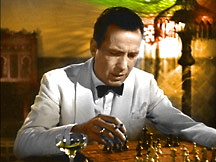
an American running his bar in Casablanca during turbulent
times, Rick managed to create a neutral oasis while
being buffeted by the local authorities and political
refugees. Hiding his social and political beliefs behind
a cynical exterior, he didn't encourage controversy
- especially in his Cafe. Remember his response to Major
Strasser's political posturing in front of Rick and
French Police Prefet Renault: "If you'll excuse me gentlemen,
your business is politics, mine is running a saloon." But when political situations became significant in
ways that touched him personally, he spoke up.
Rick also had a way of dealing with people that revealed
the compassion and loyalty that were under his gruff
exterior. Remember the young Bulgarian couple trying
to buy exit visas and the young woman's entreaties to
Rick for counsel - his response: "Take my advice, go
back to Bulgaria." He then passes by the roulette table
and through winks to the croupier ensures that the husband
wins enough to buy the exit papers. |
|
|
Rick's toughness and inherent idealism would be tested
in today's environment. Rick chose an expatriate lifestyle
(Captain Renault asks why: "Did you abscond with the
church funds. Did you run off with a senator's wife?
I'd like to think you killed a man, it's the romantic
in me." "It's a combination of all three," Rick wryly
replies.), and maybe it was because he could better
appreciate the good of his country by living outside
it than in. Contrarily, the negative aspects are more
clearly revealed if one's vantage point is outside the
U.S. - the perspective changes. It helps to access the
international press to see more discussion about global
warming, criticism of the vote to drill in the Arctic
Wildlife Refuge or the ramifications of controversial
appointments to the U.N. and World Bank. Or something
almost unheard of now in the U.S. - an investigative
press exposing plans for the disposal of Iraq's oil
reserves even before the 9/11 attacks.
The Bush administration has manipulated and in some
cases paid the national press to achieve their objectives
to the extent that it is not surprising to see the American
people willingly distracted by baseball players testifying
on steriod use, various celebrity trials or "reality
TV" programs. The reality of substantive news and commentary
is too grim for people to take.
Rick wouldn't have much patience with American escapism,
though |
|
as an expatriate, he'd be resigned to his inability
to do much about it from so far away and as a lifelong
liberal, he'd be accustomed to defeat. Still an optimist,
he'd wonder what it was going to take to expose this
dangerous agenda. He'd remember how long it took the
U.S. to join the war against fascism during the time "Casablanca" was being filmed, and how long it took
for the full implications and transgressions of Watergate
to be taken seriously. How long will it be before there
is a reaction against the extremist tendencies within
the U.S.?
I know Rick would greet warmly all those Americans who
found their way to his bar in Casablanca - just making
the trip would open up new perspectives for visitors
who might not otherwise have thought of the impact U.S.
policies in Iraq and the greater Middle East have on
other countries in the region. Rick tried to be cynical
- "The problems of the world are not in my department"
- but in the end he says to Ilsa, "I'm no good at being
noble, but it doesn't take much to see that the problems
of three little people don't amount to a hill of beans
in this crazy world." I think if Rick were here today
he'd do his best to send visitors home inspired to tell
the Rick's Café story to their friends and family as
an illustration that the spirit of "Casablanca" is as
true today as it was in 1942.
|
Kathy
Kriger March
19 2005
|
Previous
entries :
- 1
- 2-
|
|